
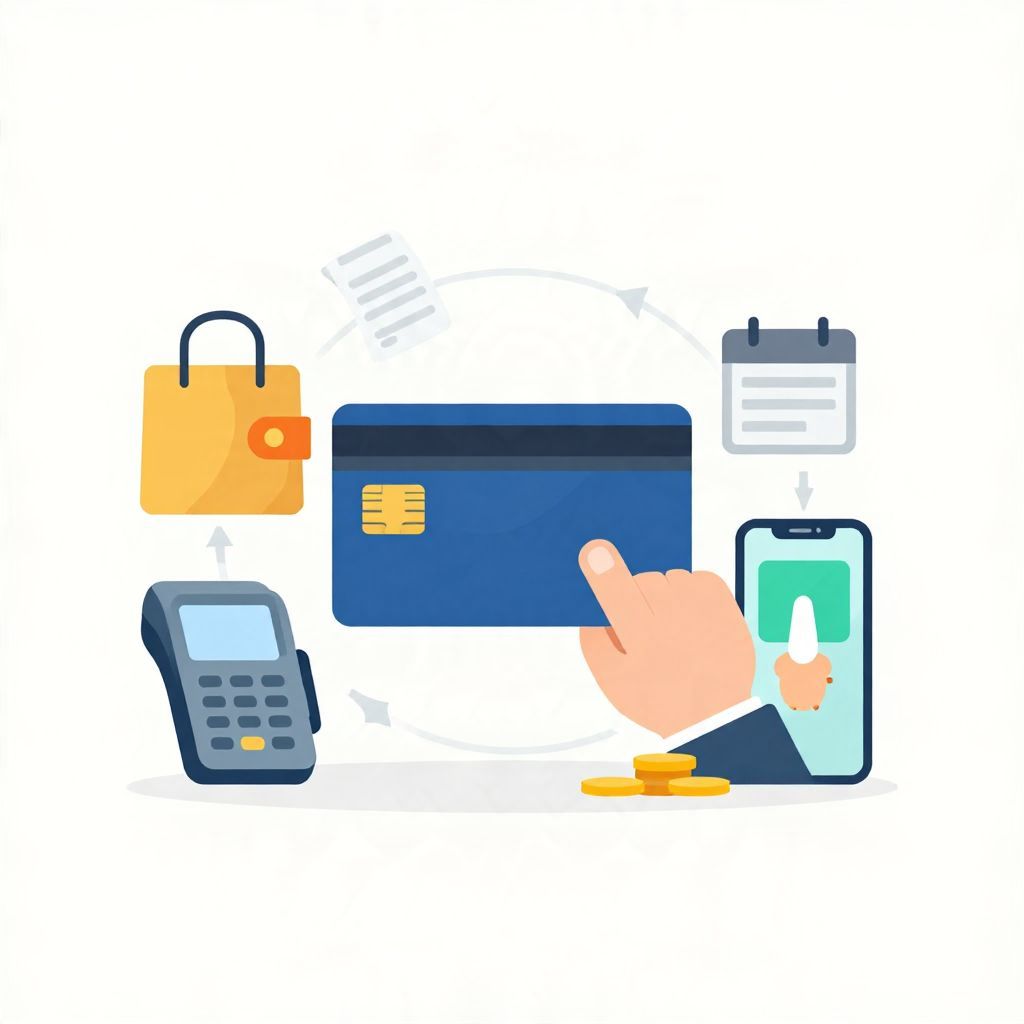
If you’re wondering how to use a credit card, the basic idea is simple: use it for purchases, keep track of what you spend, and pay the bill on time. A credit card can be a convenient payment tool, but it can also become expensive if you carry a balance or miss payments.
This step-by-step guide explains how credit cards work, how to use one safely, and what to watch for so you can build credit without creating unnecessary debt.
How To Use A Credit Card
To use a credit card, you make a purchase with the card, the issuer pays the merchant, and you repay the issuer later. If you pay the full statement balance by the due date, you usually avoid interest on new purchases. If you pay less than the full balance, interest may be charged on the unpaid amount.
Step 1: Understand the main parts of your credit card
Before you swipe, tap, or enter your card number online, it helps to know the basic terms. Credit cards are not free money; they are short-term borrowing tools with rules and costs.
Key terms to know
- Credit limit: the maximum amount you can charge.
- Statement balance: the total amount billed for the last cycle.
- Minimum payment: the smallest amount you must pay to stay current.
- Due date: the date your payment must arrive.
- APR: the annual percentage rate used to calculate interest on carried balances.
- Grace period: a period when you may avoid interest on purchases if you pay in full, depending on the card’s terms.
Exact fees, APRs, and grace-period rules vary by card issuer and country, so always read your card agreement.
Step 2: Activate the card and set up your account
Most cards must be activated before use. After that, create an online account or mobile app login so you can check balances, review transactions, and make payments.
Helpful setup actions
- Turn on transaction alerts for purchases and due dates.
- Set up autopay if you want to reduce the risk of late payments.
- Choose paperless statements if you prefer digital records.
- Store the customer service number in case the card is lost or stolen.
These features do not change how the card works, but they make it easier to manage responsibly.
Step 3: Make your first purchase
You can use a credit card in stores, online, over the phone, or in apps, depending on the merchant. At checkout, you may need to insert the chip, tap for contactless payment, swipe the magnetic stripe, or enter the card details manually.
In-store purchases
- Insert, tap, or swipe the card when prompted.
- Follow the terminal instructions and sign if required.
- Keep the receipt until the charge appears correctly on your statement.
Online purchases
- Enter the card number, expiration date, security code, and billing address if requested.
- Double-check the merchant name and amount before confirming.
- Use secure websites and avoid public Wi-Fi when entering card details.
If the charge is for a recurring service, such as a subscription, note the billing cycle so you can cancel if needed.
Step 4: Track what you spend
One of the most important parts of how to use a credit card is keeping spending within your budget. A card makes buying easy, which can make it easier to overspend if you are not paying attention.
Simple budgeting example
Suppose your monthly discretionary budget is $300. If you put $120 of groceries, $80 of gas, and $60 of dining on the card, that is $260 total. You still need to leave room for any other planned spending before the statement closes.
A good habit is to review your transactions weekly instead of waiting for the bill. That helps you catch fraud, returned items, or accidental duplicate charges early.
Step 5: Pay your bill on time
Paying on time matters because late payments can trigger fees, damage your credit history, and make borrowing more expensive. In many cases, paying at least the minimum keeps the account in good standing, but paying the full statement balance is usually the best way to avoid interest on purchases.
Payment choices
- Pay in full: Best for avoiding interest on new purchases when the card offers a grace period.
- Pay more than the minimum: Reduces debt faster and lowers future interest costs.
- Pay the minimum only: Keeps the account current, but interest may continue to build on the remaining balance.
Example: If your statement balance is $500 and the minimum payment is $25, paying only the minimum leaves $475 unpaid, and interest may be charged on that balance according to your card terms.
Step 6: Know how interest works
Credit card interest is usually based on the APR, which is an annual rate. The daily interest cost is often calculated by dividing the APR by 365 and applying it to the unpaid balance, though issuers may use slightly different methods depending on the card agreement and local rules.
Illustrative math
If a card has a 24% APR and you carry a $1,000 balance for one day, the rough daily rate is 24% ÷ 365 = 0.0658% per day. That is about $0.66 of interest for one day on $1,000. Over a month, the total interest depends on the balance, the billing cycle length, and whether you make payments during the month.
This is why paying in full matters. APR is not the same as APY, and credit card borrowing is usually more expensive than savings interest.
Step 7: Use your card to build credit responsibly
Used well, a credit card can help you build a credit history. Lenders often look at payment history, credit utilization, account age, and other factors when evaluating creditworthiness. The exact scoring method varies by country and scoring model.
Good habits for credit building
- Pay every bill on time.
- Keep balances low relative to your limit.
- Use the card regularly, but only for planned purchases.
- Keep old accounts open when appropriate, since account age can matter.
A common guideline is to keep utilization low, but there is no universal magic number that guarantees a better score. The safest approach is to avoid carrying more debt than you can comfortably repay.
Step 8: Watch for fees and extra costs
Credit cards can include fees that affect the real cost of using them. These may include annual fees, late fees, cash advance fees, foreign transaction fees, and balance transfer fees, depending on the card.
Common fee situations
- Late payment fee: may apply if you miss the due date.
- Cash advance fee: often charged when you withdraw cash with the card.
- Foreign transaction fee: may apply when you buy in another currency.
- Annual fee: charged once per year on some cards.
Fees vary widely, so it is worth reading the terms before using the card for unusual transactions like cash withdrawals or international purchases.
Step 9: Protect yourself from fraud
Credit cards offer useful consumer protections in many places, but you still need to monitor your account. Fraud can happen if someone steals your card details, your physical card, or your account login.
Fraud prevention tips
- Check statements and alerts regularly.
- Report a lost or stolen card quickly.
- Use strong passwords and two-factor authentication when available.
- Do not share your full card number or security code unless necessary.
If you see a charge you do not recognize, contact the issuer promptly. Dispute procedures and time limits depend on the card issuer and local consumer protection rules.
Step 10: Avoid common credit card mistakes
Many credit card problems come from a few avoidable habits. If you want to use a credit card well, focus on consistency rather than chasing rewards or spending more than planned.
Mistakes to avoid
- Paying only the minimum every month.
- Using credit for everyday spending without a repayment plan.
- Missing due dates.
- Taking cash advances unless absolutely necessary.
- Ignoring fees and interest after promotional offers end.
Rewards can be useful, but they are usually only worthwhile if you pay on time and in full. Otherwise, interest and fees can outweigh any points or cash back.
When using a credit card makes sense
A credit card can be a practical tool when you want convenience, fraud protection, online payment access, or a way to build credit. It can also help with planned purchases if you already have the cash to pay the bill.
Good use cases
- Routine monthly purchases you can repay in full.
- Travel bookings and online shopping.
- Emergency expenses, if you have a repayment plan.
- Building credit history through responsible use.
It is less suitable for spending you cannot repay soon, because revolving debt can become expensive quickly.
Takeaway
How to use a credit card comes down to three basics: spend carefully, track your balance, and pay on time. If you treat the card like a payment tool rather than extra income, it can be useful and manageable. For related questions, you may also want to read can you use a credit card for a down payment on a car and can I pay a credit card with a credit card.